Protecting the Underground Highway: Securing Data Center Vaults and Duct Banks

When industry professionals visualize data center security, they often picture biometric scanners, mantraps, and server cages. However, the most critical vulnerability frequently lies outside the facility walls, buried a few feet beneath the earth. This is the domain of the duct bank—the underground highway that carries the fiber optic lifeblood of the digital economy.
Duct Bank Characteristics
A duct bank is a bundled group of conduits (pipes) designed to protect and consolidate cabling—specifically fiber optics and power lines—between buildings, data centers, or utility connection points. Often encased in concrete or slurry for added mechanical protection, these banks serve as the hardened arteries of the “Outside Plant” (OSP).
While the concrete provides a physical barrier, it is not invincible. Once a duct bank leaves the secure perimeter of the data center communications vault, it traverses public rights-of-way and easements where it faces constant threats from construction crews, environmental shifts, and malicious actors.
The Challenge: Protecting the Invisible
Accidental Excavation: One threat to data cables within duct banks is accidental damage. A backhoe digging for a water main repair can crush a duct bank in seconds, severing thousands of fiber strands. Traditional security relies on “Call Before You Dig” markers, but these are passive and frequently ignored. Data center operators need active, real-time intelligence to prevent breaches before they occur.
Theft and Vandalism: Another threat is copper theft. While fiber optic cables contain no scrap value, thieves frequently mistake the thick protective jacketing for copper wire, leading them to sever critical trunk lines in a futile search for metal to sell (in other cases, the cable may contain a mix of copper and fiber). This mistaken identity yields no profit for the criminals but forces data centers to endure costly, extended outages while technicians painstakingly fusion-splice the damaged strands.
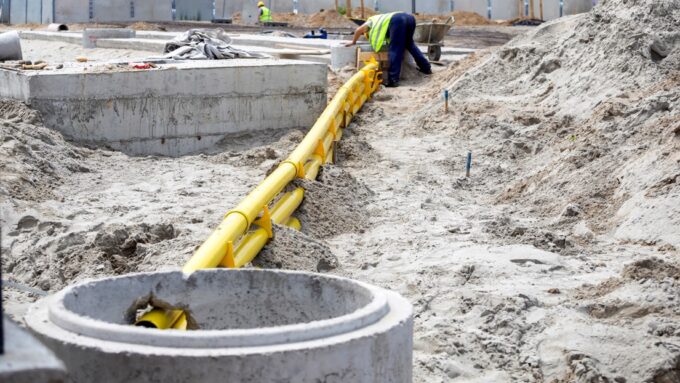
Fiber optic access point being installed during the construction of a data center
The Solution: Intelligent Sensing
Senstar offers a multi-layered approach to turning these passive concrete structures and buried fiber into smart, self-monitoring assets.
Senstar FiberPatrol FP1150 (Subsurface Protection)
The most effective method for securing a duct bank is to utilize one of the fibers as a sensor. The FiberPatrol FP1150 utilizes Distributed Acoustic Sensing (DAS) technology to monitor the physical state of the fiber optic cables running through the ducts.
It detects the acoustic signatures of ground disturbance, such as manual digging or heavy machinery as well as interference with steel vault covers, over fiber distances of up 100 km (62 miles). Crucially, it provides early warning; the system can detect the vibration of an excavator approaching the duct bank before the bucket strikes the concrete or metal casing, allowing security teams to intervene and stop the work.
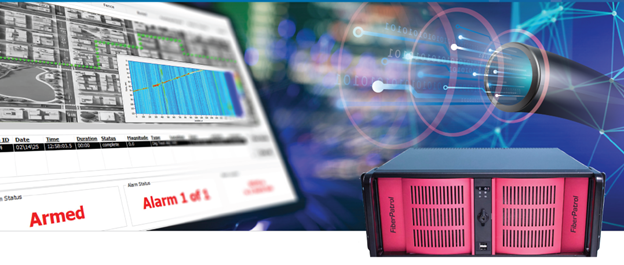
Senstar’s FiberPatrol FP1150 can detect, locate, and classify security threats to buried fiber optic cables with an accuracy of ±4 m (10 ft) and over cable distances of up to 100 km (62 mi).
Protecting the Above-Ground Link
Not all duct bank infrastructure remains buried; inevitably, these lines must surface at specific nodes, such as bridge crossings, risers entering buildings, or transition points at utility substations.
Protecting this exposed, above-ground infrastructure requires a different approach. Senstar Smart 3D LiDAR and Intelligent Video Analytics create virtual shields around these vulnerable assets. LiDAR sensors can generate a volumetric “curtain” around a riser or conduit run, detecting any object that enters the protected 3D space. These systems can distinguish between a maintenance vehicle and a pedestrian, and detect abnormalities such as left items (potential explosive or sabotage tool) placed near an exposed conduit. This ensures that even when the “underground highway” surfaces, it remains under constant, active protection.
The High Cost of Inaction
The impact of damage, tampering, or interference with data cables cannot be overstated. A severed fiber trunk results in immediate operational paralysis, with downtime costs for hyperscale facilities potentially exceeding $9,000 per minute.
Unlike a copper wire that can be twisted back together, repairing a high-count fiber cable requires specialized fusion splicing of glass strands—a process that takes hours or even days. Beyond the direct financial loss, such incidents can violate Service Level Agreements (SLAs), incur massive liability for lost data, and permanently damage a data center’s reputation for reliability.
By deploying physical security technologies, data center operators move from a reactive posture—fixing breaks after they happen—to a proactive one, securing the physical layer that makes the cloud possible.
From Alert to Action: The Power of Integration
To ensure a rapid response to potential threats, integration with the organization’s VMS, SMS or PSIM is critical. Senstar’s open architecture supports integrations with all industry-standard systems. These integrations ensure that when a sensor detects a threat, security teams receive immediate, map-based alerts directly within their existing control room interface to establish rapid situational awareness.
To learn More
To learn more about Senstar security technologies for data centers, download our free Physical Security For Data Centers guide.